
'Taxpayers' money cannot be given to these companies which can access the market and buy GPUs at a competitive price from any vendor.'

Her reasoning is simple, "It's a Tata company. No shareholder will let go of this opportunity," she told Business Standard. When asked if the other reason for lining up for the IPO is the technology sector and the fact that the combination of Tata and tech is happening after almost two decades, she replied: "The name of the company and the group matter. Tata means stability and credibility," she added.

Shivanand Kanavi remembers his father, the eminent Kannada poet Nadoja Chennaveera Kanavi.

Office space owners are looking at good times ahead as rentals are expected to rise due to demand for Grade A office spaces outpacing supply that has been sluggish due to construction delays, long gestation periods and developers' interests shifting to residential.

'We've maintained that India is a high-penetration game. It's not only a premiumisation game.'

There is no impediment to normal operations as Tata Motors puts in place the demerger process of its commercial and passenger vehicles businesses. Instead, the demerger would provide greater manoeuvrability for both new entities to operate independently, according to Tata Motors management. While there may not be immediate value unlocking, it will give investors clarity about future growth and the financials across different segments.

Billionaire Mukesh Ambani's Reliance Industries Ltd has spent $13 billion on acquisitions in the past five years across new energy, telecom, retail and media business to script a pivot away from core oil and petrochemicals business to clean energy and consumer facing verticals. Last week, Reliance bought oncology platform Karkinos Healthcare for Rs 375 crore, adding another stack to its diagnostic and digital healthcare ecosystem, Morgan Stanley said in a report.

India's largest IT services firm Tata Consultancy Services on Thursday reported a 1.68 per cent dip in its consolidated net profit to Rs 12,224 crore for the March 2025 quarter. Tata Consultancy Services (TCS) - whose earnings marked the official start of IT results season - reported a total revenue of Rs 64,479 crore in Q4 FY25, up 5.3 per cent over the year-ago period.

Passenger vehicle sales in India kicked off on a flat note in new fiscal 2024-25 with 3.38 lakh units sold in April, impacted by high base effect and muted demand due to the ongoing general elections. Dispatches of passenger vehicles from manufacturers to dealers were at 338,341 units in April 2024 as compared to 332,468 units in the same month last year, a growth of 1.77 per cent with major players Maruti Suzuki India, Hyundai and Tata Motors reporting marginal growth in their domestic wholesales.

The stock of fast-moving consumer goods major Tata Consumer Products has been reaching new all-time highs on better-than-expected results for the July-September quarter (second quarter, or Q2), strong growth in the food business, and margin gains in the beverage/international business. Most brokerages are positive on the stock, given growth prospects, and believe that rich valuations are justified. The near-term trigger has been the robust operational performance in Q2.

We are adapting to the situation by innovating new delivery modelss, launching brand campaigns that are impactful in the current context and closely monitoring changes in consumer buying behaviour, he said.

The only silver lining in March's performance -- which otherwise dragged down the financial year's momentum -- was a 6 per cent year-on-year (Y-o-Y) growth compared to March of the previous year. This is largely due to incentives, festival-driven gains, and new launches.

'Every delay directly increases the cost burden on developers. Land holding charges, financing costs, and compliance expenses escalate as approvals drag on.'


From the Sensex pack, Bajaj Finserv, IndusInd Bank, NTPC, Larsen & Toubro, UltraTech Cement, Adani Ports, Bajaj Finance, Power Grid, Zomato, State Bank of India, HDFC Bank and Titan were the biggest gainers. Tata Motors tanked over 5.5 per cent after US President Donald Trump announced he would impose 25 per cent tariffs on imported cars. Sun Pharma, Kotak Mahindra Bank, Bharti Airtel, HCL Tech and Mahindra & Mahindra were also among the laggards.

Early-bird results for the January-March 2025 quarter (Q4FY25) suggest a slowdown in earning growth for India Inc, despite a benign cost environment that has led to an improvement in margins. The combined net profit (adjusted for exceptional gains and losses) of 175 early-reporting companies rose by 3.8 per cent year-on-year (Y-o-Y) in Q4FY25, marking the slowest growth in 17 quarters.

'Could the impending new crisis, vibe coding, similarly create not a disaster like what befell Indian handlooms during the Industrial Revolution but another opportunity like what the Y2K crisis created?' asks Ajit Balakrishnan.

Brokerages expect a further slowdown in Indian firms' revenue and earnings growth in Q4FY25, following low single-digit growth in the preceding three quarters, as factors like weak consumer demand and credit growth linger on.

Tata group retail firm Trent Ltd reported a 34 percent increase in consolidated net profit to Rs 496.54 crore in the December quarter, helped by the expansion of the store network and increase in attractive value propositions. The company's consolidated revenue from operations grew 34.32 per cent to Rs 4,656.56 crore during the quarter under review. Trent is also pursuing store portfolio optimization, which involves upgrading or consolidating smaller footprint stores with newer stores in more attractive micro markets.

The process of identification of victims by matching the DNA samples is currently underway, and the bodies will be handed over to their relatives once the process is complete.

With nearly 100 launches and unveils, the Bharat Mobility Global Expo 2025, held in Delhi from January 17 to 22, made one thing clear to automobile enthusiasts: Electric vehicles (EVs) are the way ahead for the Indian auto market for years to come.

The next Census' findings will help identify the extent of India's ageing population and vulnerability levels.

Investors seem to be shying away from stocks of companies in the 'digital' space with most counters that comprise the Nifty India Digital index giving negative returns over the past year. The index tracks the performance of a portfolio of stocks that broadly represent the 'digital theme' within basic industries, such as software, e-commerce, IT-enabled services, industrial electronics, and telecom services. The fall in some of these stocks over the past year has been steep; the sharpest decline of around 60 per cent was seen in shares of PB Fintech (parent company of Policybazaar).

The Street's optimism on India's largest listed automotive maker by market capitalisation is not misplaced, given the robust wholesale performance in recent months and the strong 2023-24 (FY24) October-December (Q3) results.

Tata Communications on Wednesday announced that it would acquire NYSE-listed Kaleyra, a global omnichannel integrated communication services provider with a set of proprietary platforms offering targeted personalisation through messaging, video, push notification, e-mails and voice-based services, and chatbots. The acquisition is an all cash deal. Tata Communications has agreed to acquire Kaleyra at a price per share of $7.25, for a total consideration to Kaleyra shareholders of approximately $100 million, besides the assumption of all outstanding debt.

Mukesh Ambani-owned RIL's JioMart is set to launch a slew of new products including financial services, electronics to airline tickets to take on the competition from upcoming rivals like the Tata Super app and other established players including PayTM, Amazon and Flipkart. This comes at a time when RIL's e-commerce revenues are set to grow by 35 per cent to $15 billion within four years and its core retail revenue is expected to grow at the same pace to $44 billion, as per a forecast by Goldman Sachs. "The Tata vs JioMart war will be the next big corporate battle to watch. "While Tata has an upper hand like in-house products and brands, RIL has the backing of global biggies like Google, Facebook and Microsoft," said head of a rating firm asking not to be quoted.

Maruti Suzuki India and Hyundai reported single-digit sales growth in July with the sports utility segment continuing to drive overall demand in the market. Mahindra & Mahindra witnessed a 29 per cent increase in passenger vehicle dispatches while Tata Motors saw a marginal increase in the wholesales last month. Maruti Suzuki on Tuesday said its total domestic passenger vehicle sales stood at 152,126 units last month as compared to 142,850 units in the year-ago month, a growth of 6 per cent.

From its lows in December, the stock of Tata Motors is up about 15 per cent. The gains came on the back of better than expected December volumes in its UK-based subsidiary Jaguar Land Rover (JLR). This coupled with gradual recovery in the global passenger vehicle demand, improving profitability due to product mix and lower commodity costs are expected to be key positives for the company.

'Investors with as little as Rs 1 can start investing in digital gold.'

rediffGURU Ulhas Joshi recommends five factors you need to look at to evaluate the performance of two schemes.
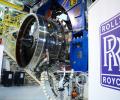
Aerospace major Rolls-Royce has announced its intention to double its supply chain sourcing from India over the next five years. The company plans to increase sourcing of complex parts for advanced aerospace engines, naval propulsion systems, diesel engines, and gas turbine engines to grow its presence and participation in India's defense sector. Rolls-Royce currently sources a wide range of high-precision parts and engine components from Indian partners for its civil aerospace, defense, and power systems businesses. The company highlights India's emergence as a preferred global sourcing hub and emphasizes its commitment to strengthening partnerships with both existing and potential Indian suppliers to develop capabilities for manufacturing complex engine components locally for global markets. Rolls-Royce highlights its established ecosystem of strategic partnerships, skilled talent, engineering and digital capabilities, service delivery, supply chain, and manufacturing in India, along with a history of successful technology transfer for licensed production of various engines in the defense domain. The company believes that strengthening the supply chain and enhancing ecosystem capabilities will pave the way for future co-production opportunities, supporting India's vision of becoming a self-reliant defense powerhouse. Rolls-Royce emphasizes its commitment to serving the needs of India's armed forces and its focus on participating in co-development opportunities for critical combat engine technologies.

From November 12, Vistara aircraft will be operated under Air India's banner, identifiable by a special four-digit flight code beginning with '2'. For example, flight UK 955 will become AI 2955, making it easier for customers to recognise when booking on airindia.com after this date.

Indian engineering research and development (ER&D) players, such as Tata Technologies, Tata Elxsi, and Cyient, among others, had a subdued January-March quarter of 2023-24. The outlook for 2024-25 (FY25) also remains unexciting amid weak discretionary spending, prompting analysts to revise their growth expectations for the ongoing financial year (FY25).

In the two-wheeler segment, Bajaj Auto reported 31 per cent jump in total sales at 357,883 units in February against 273,513 units in the same month last year.

India has secured the second position, contributing 36 per cent of the total brand value, a significant achievement fuelled by a 14 per cent increase in brand value, according to Brand Finance 2025 ranking. India follows the US, which maintains its dominant position in IT services brand value, holding 40 per cent of the total brand value.

Social media platform Meta has appointed Vikas Purohit as Director of Global Business Group in India to lead the strategy and delivery of the charter that is focused on the country's leading advertisers and agency partners, the company said on Monday. Purohit will report to Arun Srinivas, director and head of ads business for Meta in India, it said in a statement. "I am thrilled to welcome Vikas as he joins our team to shape the role that Meta platforms can play in enabling businesses, supporting India's economic growth, and building the digital advertising ecosystem of the country," Srinivas said.

Digital, new energy, supply chain resilience and health will be the themes of the over $100-billion Tata group's strategy going forward, according to its chairman N Chandrasekaran even as he asserted that all ambitions are contingent on learning to live with the coronavirus. In his New Year address to the over 8 lakh employees of salt-to-software conglomerate, Chandrasekaran said businesses and society must adapt to the virus by preparing as "best we can for new outbreaks and variants. We are seeing this now with the spread of Omicron". Reflecting on the year gone by, he said the group is becoming "simpler and financially stronger than we have been in a long time".

Global engineering and product development digital services firm Tata Technologies on Monday said it has been selected by European aerospace major Airbus as a strategic supplier. The company will become an engineering, manufacturing engineering and services strategic supplier (EMES3), Tata Technologies said in a statement. "This is an outcome of an extensive seven month long multi-phased procurement assessment process that covered all Airbus divisions, subsidiaries, and affiliates across engineering, manufacturing engineering, and customer services engineering functions," it added.

'The competition between the two is definitely going to be of great interest to the Indian market.'

'The favourable rupee-dollar exchange rate, there are opportunities we can tap.'
